


If you brush twice a day, floss most of the time, and still deal with breath that doesn’t stay fresh or gums that feel a little off by evening, you’re not doing anything wrong. You might just be missing a piece of the picture that traditional oral care never really addressed: the trillions of bacteria that live in your mouth every single day.
That’s where oral probiotics come in. But before jumping into how they work, it helps to understand what’s actually going on inside your mouth in the first place — because probiotics don’t do anything mysterious. They work with something that’s already there.
What Is the Oral Microbiome, Really?
Your mouth is home to over 700 different species of bacteria, along with fungi and other microorganisms, living on your teeth, gums, tongue, and cheeks. Together, this community is called the oral microbiome, and it’s honestly one of the most active microbial environments anywhere in the human body.
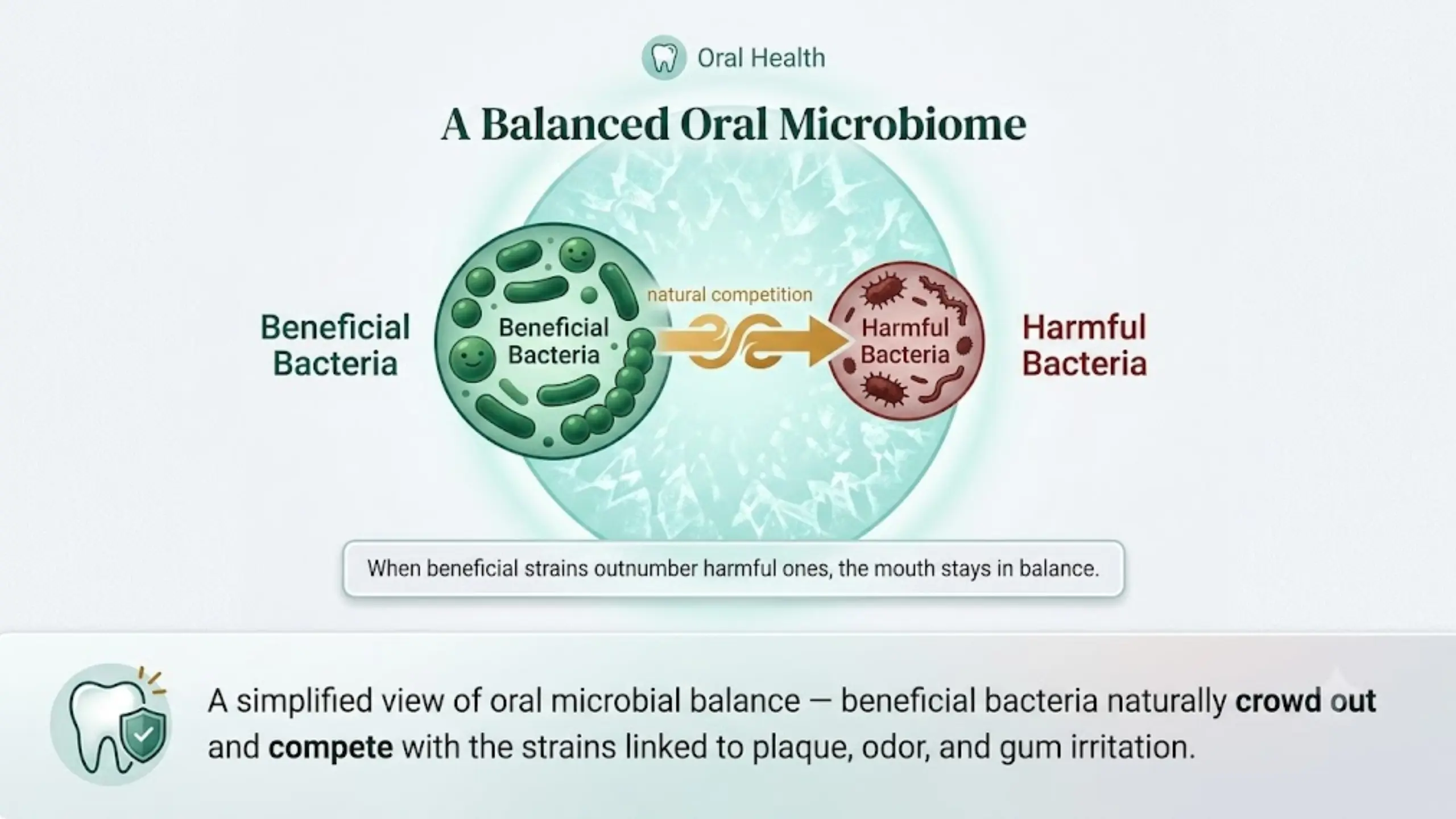
Not all of these bacteria are troublemakers. In fact, most of them are either harmless or genuinely helpful. Some strains help break down food particles, some help regulate pH levels in your mouth, and others directly compete against the bacteria that cause plaque, bad breath, and gum irritation. Problems tend to show up not because bacteria exist, but because the balance between helpful and harmful strains gets thrown off — a state researchers call dysbiosis.
Diet, stress, certain medications, dehydration, mouthwash overuse, and even how much sleep you get can all shift this balance. When harmful bacteria start to outnumber the beneficial ones, that’s usually when people start noticing symptoms — persistent bad breath, more plaque buildup, or gums that feel sensitive by the end of the day.
Where Oral Probiotics Fit Into This Picture
An oral probiotic is simply a supplement that introduces live, beneficial bacterial strains directly into the mouth, usually through a lozenge or chewable tablet rather than a capsule you swallow whole. The idea is straightforward: instead of trying to wipe out bacteria indiscriminately (which is what alcohol-based mouthwash tends to do), you’re adding reinforcements to the side that’s already working in your favor.
Strains commonly used in oral probiotics include Lactobacillus reuteri, Lactobacillus paracasei, and Streptococcus salivarius. Research on these strains has looked at their role in supporting gum comfort, competing with odor-causing bacteria, and helping maintain a more favorable environment in the mouth overall.
The Mechanism, Step by Step
- Introduction: The tablet dissolves slowly in the mouth, releasing live bacterial strains directly where they’re needed, rather than passing through the digestive system first.
- Colonization attempt: These strains attach to the same surfaces — teeth, gums, tongue — where harmful bacteria also try to establish themselves.
- Competition for space and resources: Beneficial bacteria compete with harmful strains for the same nutrients and attachment sites, which can limit how much room the harmful bacteria have to multiply.
- Byproduct effects: Some beneficial strains produce natural compounds that create a less hospitable environment for odor-causing and plaque-forming bacteria.
- Reinforcement through consistency: Because the oral microbiome resets somewhat every day through eating, drinking, and brushing, daily use is what allows beneficial strains to keep a foothold rather than being a one-time fix.
This is also why oral probiotics are described as working “alongside” your existing routine rather than replacing it. Brushing and flossing physically remove plaque and food debris; probiotics work on the microbial balance underneath. They’re solving two different parts of the same problem.
What a Realistic Timeline Looks Like
One of the most common questions people have is simply: when will I actually notice something? The honest answer is that it varies by person, because everyone starts with a different baseline microbiome. That said, here’s a general pattern based on how bacterial colonization typically progresses.
- Day 1–3: Introduction phaseBeneficial strains begin dissolving into the mouth daily. At this stage, there’s usually no noticeable change yet — the bacteria are just starting to establish a presence.
- Week 1–2: Early adjustmentSome people report a subtle difference in how their mouth feels, particularly around freshness. This is also when any mild adjustment effects (if they happen at all) tend to settle down.
- Week 3–4: Building consistencyWith daily use, beneficial bacteria have more opportunity to compete for space against harmful strains. This is typically when people start to notice more consistent freshness throughout the day, not just right after brushing.
- Week 5–8: Established routineBy this point, the daily habit has had time to reinforce itself. Many users report the difference feels more like a stable part of their normal mouthfeel rather than something they have to think about.
- Ongoing: MaintenanceBecause the mouth’s bacterial balance is constantly influenced by diet, hydration, and daily habits, continued use is what maintains the shift rather than a single course “fixing” things permanently.
Why This Approach Differs From Mouthwash
Traditional antiseptic mouthwash is built to kill bacteria on contact, and it doesn’t really distinguish between the helpful strains and the harmful ones. That’s effective for a quick reset, but it also means the mouth’s bacterial population gets to start over shortly after, often without any advantage given to the beneficial strains.
Oral probiotics take the opposite approach — instead of clearing the field, they try to tip the balance of who’s occupying it. Neither approach is inherently “wrong,” but they’re solving the problem in fundamentally different ways, which is why some people use both a probiotic and a standard oral care routine rather than choosing one over the other.
Common Questions About How Oral Probiotics Work
Do I need to take it at a specific time of day?
Most guidance suggests taking oral probiotics after brushing, since a clean mouth gives the beneficial bacteria a more open surface to work with, rather than competing with leftover food particles.
Can the effect wear off if I stop?
Because the oral microbiome is constantly influenced by what you eat, drink, and how you care for your teeth, most researchers describe microbial balance as something that needs ongoing support rather than a one-time correction — similar to how gut probiotics are typically discussed.
Is it normal not to feel anything right away?
Yes. Bacterial colonization is a gradual process, not an instant one. Expecting immediate results is one of the most common reasons people give up on oral probiotics before the beneficial strains have had a real chance to establish themselves.
Sources & Further Reading
- Frontiers in Microbiology — The Oral Microbiota: Community Composition, Influencing Factors, Pathogenesis, and Interventions
- PMC / NIH — Oral Microbiome: Unveiling the Fundamentals
- Journal of Oral Microbiology — Probiotics in Oral Health, a Comprehensive Review
- Frontiers in Dental Medicine — Probiotics in Gingivitis Management
- Periodontology 2000 — Clinical Use of Probiotics in Periodontal Health