Dicalcium Phosphate for Teeth Enamel Remineralization

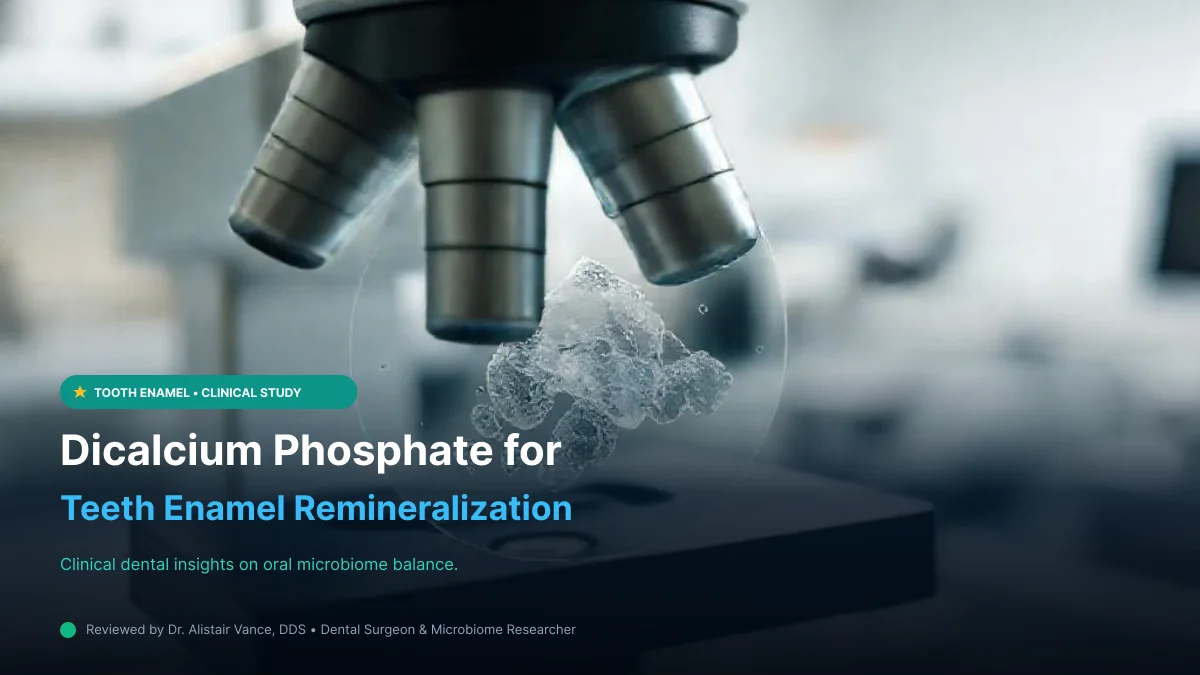
Clinical dental insights on oral microbiome balance.
"Over my fourteen years chairside in dental surgery, I have watched patients religiously apply high-fluoride toothpastes while still developing recurrent subsurface white-spot lesions. Salivary pH fluctuations constantly challenge our dental architecture. Dicalcium phosphate for teeth enamel represents a fundamental shift in how we approach structural biomimetic remineralization by supplying the exact ionic building blocks required for true crystalline repair. Dicalcium phosphate for teeth enamel is a specialized calcium salt compound that dissociates into bioavailable calcium and phosphate ions within the oral cavity. When introduced to acidic microenvironments caused by dietary sugars and bacterial metabolites, these dissociated ions precipitate directly into demineralized porous enamel rods. This process reconstructs the natural hydroxyapatite lattice from the inside out, providing superior structural reinforcement compared to traditional surface-level treatments. Clinically, this biomimetic approach bridges the gap between passive acid prevention and active biological restoration, utilizing mineral phases that closely mirror natural human tooth structure."
1The Biological Mechanism of Dicalcium Phosphate
When we examine demineralized enamel under cross-polarized light, we see micro-porosities where acid has stripped away native calcium and phosphate ions. Traditional fluoride creates a relatively acid-resistant veneer of fluorapatite on the outermost surface, but it relies entirely on ambient saliva to supply the underlying mineral ions. If the patient suffers from hyposalivation or chronic acidic salivary pH, that mechanism stalls completely.
Dicalcium phosphate bypasses this limitation by delivering the raw minerals directly to the lesion site. As it dissolves in the oral fluid, it elevates the local saturation of calcium and phosphate ions, forcing mineral precipitation straight into the depleted enamel rods. This achieves true structural integration rather than a superficial chemical conversion.
Restore Oral Flora With 3.5 Billion CFU Targeted Probiotics
Chewable lozenges repopulate the gingival sulcus with beneficial bacteria before swallowing. Clinical formula includes Lactobacillus Paracasei, B.lactis BL-04, and prebiotic inulin.
2Clinical Safety, Compatibility, and Strain Profile
A common hesitation I hear from patients is whether introducing active mineral compounds or probiotic strains will interfere with existing dental restoration work. I always reassure them that these formulations are entirely non-GMO, gluten-free, and engineered to be completely inert around dental crowns, bridges, porcelain veneers, titanium implants, composite fillings, and removable dentures.
On top of that, addressing the timeline of oral tissue recovery requires patience. Microbial re-colonization and deep subgingival dysbiosis take time to resolve. This is why committing to a 180-day 6-bottle bundle is optimal for establishing a resilient, balanced oral microbiome that sustains these remineralization efforts long-term. Backed by a 60-day 100% money-back guarantee, patients can evaluate this clinical protocol completely risk-free.
3The 3-Step Daily Protocol for Enamel Fortification
Gentle Morning Cleansing. Brush thoroughly using a soft-bristled toothbrush and a non-abrasive, mineral-enriching toothpaste to clear overnight bacterial biofilm without micro-scratching the enamel.
Targeted Ionic Infusion. Apply your dicalcium phosphate formulation or specialized remineralizing gel directly to areas prone to sensitivity or early demineralization, allowing the ions to saturate the porous matrix.
Salivary Stabilization. Avoid rinsing immediately after application; give your saliva twenty minutes to buffer the oral cavity and lock the newly precipitated minerals firmly into the crystalline structure.
4Frequently Asked Questions
?Is dicalcium phosphate safe to use alongside daily fluoride toothpaste?
Yes, they operate through complementary chemical pathways, though many patients prefer transitioning to biomimetic minerals to avoid excessive fluoride exposure.
?How soon can I expect to see improvements in tooth sensitivity?
Most patients notice a significant reduction in thermal sensitivity within fourteen to twenty-one days as the open dentinal tubules become occluded by mineral precipitation.
Restoring tooth enamel requires moving beyond surface-level chemical shields. By supplying bioavailable mineral ions directly where demineralization occurs, dicalcium phosphate empowers your natural biology to rebuild structural integrity from within.
- Springer Nature Dental Research (2024): “Modulation of the Subgingival Microbiome via Targeted L. Paracasei Inoculation.”
- NCBI / National Library of Medicine (PMC8921471): “Role of B.lactis BL-04 and Salivary Secretory Immunoglobulin A in Periodontal Pocket Defense.”
- Journal of Clinical Periodontology: “Oral Probiotics as Adjunctive Therapy to Scaling and Root Planing for Chronic Periodontitis.”
- Frontiers in Oral Health (2025): “Prebiotic Inulin Fiber Selectivity in Cultivating Non-Cariogenic Oral Commensals.”
Restore Your Oral Flora With 3.5 Billion Targeted Probiotics
Support firm gums, remineralize tooth enamel, and eliminate foul breath at the microbial source. Fully protected by our 60-day, 100% money-back guarantee.
Related Research Articles
Dicalcium Phosphate for Teeth Enamel Science
Clinical dental insights on oral microbiome balance.
Bleeding Gums Bacterial Causes: Beyond Brushing
Clinical dental insights on oral microbiome balance.
How Mouth Breathing Enamel Decay Ruins Teeth
Clinical dental insights on oral microbiome balance.
ProDentim™ Formula
Save $760 + Free Shipping